Not a contractor. Lead referral platform covering Portland's 10 deepest cost markets.
WHAT CEDAR SHAKE ACTUALLY COSTS IN PORTLAND
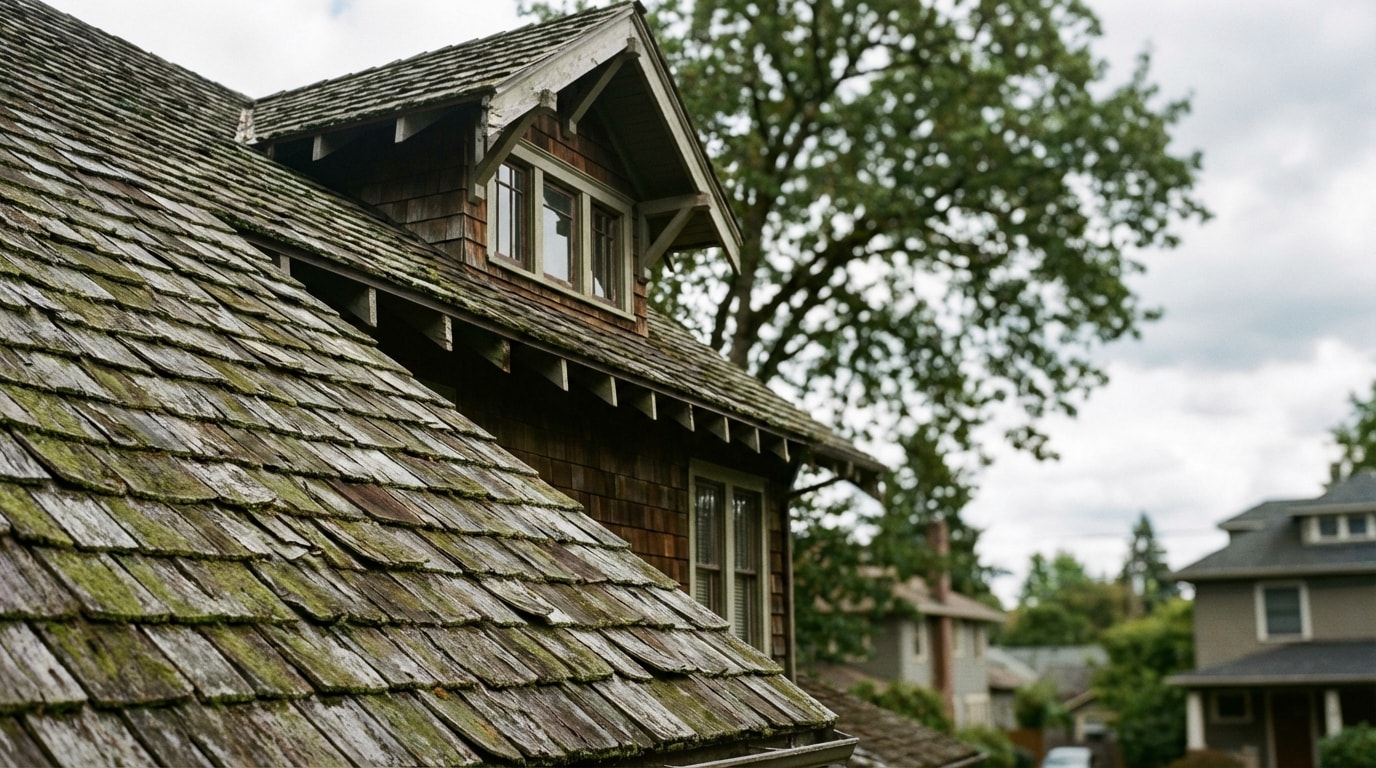
Cedar shake retrofit-in-kind is the dominant project type in Portland's heritage neighborhoods, Eastmoreland, Irvington, Lake Oswego Country Club / Lake Forest, and listed properties scattered throughout Inner SE and NE. The economics differ fundamentally from architectural asphalt because cedar is partly a heritage character mandate and partly a maintenance commitment, not a pure cost-performance choice. A typical Eastmoreland cedar retrofit runs $22,000–$32,000; the equivalent home with architectural asphalt would run $12,000–$15,000.
Hand-split versus Resawn cedar is the choice that drives most of the cost spread. Hand-split #1 grade Western red cedar offers the heritage profile with deep texture variation that design review favors on landmark properties; Resawn cedar is sawn rather than hand-split, has a more uniform appearance, and costs $4,000–$6,000 less on a typical project. Eastmoreland design review specifically pushes back on Resawn substitution on contributing properties; Lake Oswego HOAs vary by sub-association. Confirm material requirements with your specific design authority before signing, the binding decision is the reviewer's, not the contractor's.
Pressure-applied fire retardant treatment is essential on cedar shake projects in Portland. The treatment achieves Class B fire rating (Class A requires synthetic substrates) and is required by most design review boards as part of a complete cedar shake system. Cost runs $1,200–$2,400 depending on roof size. The treatment lasts 7–10 years before renewal needed; renewal runs roughly 60% of original treatment cost. Untreated cedar in Portland's climate combined with moss and biological growth risks fire propagation that insurance carriers increasingly underwrite against.
Maintenance is what kills cedar projects that weren't budgeted properly upfront. Without biennial moss treatment ($300–$700 per cycle) and prompt repair of cracked or cupped shakes ($200–$800 per repair event), Portland cedar shake fails in 14–18 years vs. the 25–30 advertised. With proper maintenance, twice-yearly inspection, biennial chemical treatment, and prompt repair, Portland cedar reaches 25–30 years with care. Factor 25-year ownership cost: cedar retrofit + maintenance runs $32,000–$48,000 vs. premium architectural at $14,000–$18,000. The case for cedar is heritage character, not cost.
Cedar shake in Portland's climate requires active maintenance. Without biennial moss treatment and prompt repair of cracked or cupped shakes, a 25-year rated product can fail in 14–18 years. Factor maintenance costs into your total cost of ownership comparison against metal or premium asphalt.
WHAT MOVES CEDAR SHAKE QUOTES
The factors that move cedar shake roofing quotes most in Portland, with quantified impact and the explanation behind each. Use these to evaluate whether a contractor's bid reflects local conditions or is missing something.
Hand-split #1 grade is the heritage profile design review favors on landmark Eastmoreland and Irvington properties. Resawn acceptable on most non-contributing properties.
Required by HOA in most Country Club/Lake Forest/First Addition Lake Oswego sub-associations and favored by Eastmoreland design review on contributing properties. Copper outlasts galvanized by 30+ years.
Required for Class B fire rating. Standard requirement on most design review boards. Treatment lasts 7-10 years before renewal.
Eastmoreland, Irvington listed historic districts; Ladd's Addition; Portland Historic Resource Inventory properties.
Cedar shake installation requires specific training. Generalist roofers produce installations that fail at 14-18 years. Specialist labor rates are higher.
Country Club, Lake Forest, First Addition sub-associations frequently mandate cedar in kind. Material substitution requires formal HOA approval.
Biennial moss treatment, fire retardant renewal at year 7-10, repair of cracked/cupped shakes. Typically not budgeted at install but real over ownership.
REAL CEDAR SHAKE BREAKDOWNS
Three representative Portland cedar shake roofing projects with line-item breakdowns drawn from typical local housing stock. Use these to anchor what your own quote should look like.
| Tear-off existing cedar shake (significant disposal weight) | $3,400 |
| Synthetic underlayment + ice-and-water at eaves | $880 |
| Hand-split cedar shake, #1 grade Western red | $13,800 |
| Copper flashing throughout (design review requirement) | $3,200 |
| Pressure-applied fire retardant treatment | $1,600 |
| Multi-gable trim and valley detail | $2,400 |
| Ridge ventilation rebuild | $880 |
| Eastmoreland Historic District design review submission | $420 |
| Permit + BDS inspection | $520 |
| Cleanup and disposal | $580 |
| Total | $27,700 |
Note: Premium Eastmoreland Tudor retrofit. Hand-split #1 grade and copper flashing both reflect design review preference for landmark properties. Resawn cedar with galvanized flashing would have come in roughly $5,500 cheaper but design review pushed back, the home is contributing to the historic district character and reviewers wanted heritage material profile.
| Tear-off existing cedar shake | $4,200 |
| Synthetic underlayment + ice-and-water at eaves | $1,100 |
| Hand-split cedar shake, #1 grade Western red | $18,400 |
| Copper flashing throughout | $3,200 |
| Pressure-applied fire retardant treatment | $1,800 |
| Ridge ventilation rebuild | $880 |
| Crane day for upper-roof material staging | $1,400 |
| HOA design review + Lake Oswego permit | $680 |
| Cleanup and disposal | $680 |
| Total | $32,340 |
Note: Premium Lake Oswego cedar retrofit. Hand-split #1 grade is the upper tier, Resawn at $14,000-$15,000 would have come in roughly $4,000 cheaper. Copper flashing is non-negotiable for cedar at this tier; galvanized would void HOA approval. Crane day required for hillside upper-roof access.
| Tear-off existing cedar shake | $2,800 |
| Synthetic underlayment + ice-and-water at eaves | $680 |
| Resawn cedar shake, #2 grade Western red (acceptable for non-contributing) | $8,400 |
| Galvanized flashing (acceptable per Ladd's design review) | $1,200 |
| Pressure-applied fire retardant treatment | $1,400 |
| Ridge ventilation rebuild | $680 |
| Type II Historic Resource Review submission | $580 |
| Permit + BDS Inspection | $420 |
| Cleanup, disposal | $520 |
| Total | $16,680 |
Note: Lower-tier cedar retrofit on a non-contributing property where design review accepted Resawn cedar with galvanized flashing. The contributing-property version (hand-split #1 grade + copper) would have run $22,000-$24,000. Confirming property contribution status before signing is essential.
CEDAR SHAKE MATERIALS, PORTLAND-SPECIFIC GUIDANCE
Each material has a different cost-performance profile in Portland's climate. Pros and cons below reflect real-world PDX experience, not generic manufacturer marketing.
HAND-SPLIT #1 GRADE WESTERN RED CEDAR
Best for: Landmark Eastmoreland and Irvington properties, premium Lake Oswego HOA mandates
- +Heritage character match for early-20th century homes
- +Required by design review on most contributing properties
- +Distinctive deep texture variation
- +Best wind performance among cedar options
- +Premium aesthetic
- −3-5x premium over architectural asphalt
- −Specialist installer required
- −Demanding maintenance schedule
- −Without treatment, life cuts in half
- −Color and grain variation that some find inconsistent
Hand-split #1 grade is the heritage profile that Eastmoreland and Irvington design review specifically favors on contributing landmark properties. On non-contributing properties or in Lake Oswego HOAs that allow it, Resawn cedar is acceptable and cheaper. Confirm property contribution status before specifying material.
RESAWN (SAWN) WESTERN RED CEDAR
Best for: Non-contributing properties, mid-tier cedar projects, HOA-approved alternatives
- +$4,000-$6,000 cheaper than hand-split on typical project
- +More uniform appearance
- +Easier to source consistent batches
- +Acceptable to most design review on non-contributing properties
- +Same maintenance schedule as hand-split
- −Less heritage character, looks more uniform/manufactured
- −Not approved by some Eastmoreland sub-districts on contributing properties
- −Same fire/maintenance requirements as hand-split
- −Grain pattern less distinctive
Resawn cedar is the cost-effective compromise for owners who want cedar character without the hand-split premium. Design review approval varies, Eastmoreland tends to push back on landmark properties; Irvington is more flexible; Lake Oswego HOAs vary by sub-association. Submit material specifications during design review, not after.
PRESSURE-TREATED CEDAR SHAKE
Best for: Wet shaded canopied areas where untreated cedar fails fastest
- +Factory pressure treatment with fire retardant + preservative
- +Reduces moss colonization
- +Extends real-world life by 5-8 years vs. untreated
- +Class B fire rating without field treatment
- +Same heritage appearance as untreated
- −20-30% premium over untreated cedar
- −Treatment must be specified and verified
- −Smaller supplier pool
- −Some design review boards prefer untreated for character
- −Treatment effectiveness varies by manufacturer
Pressure-treated cedar is the smart spec for owners committing to cedar long-term in heavily canopied Portland neighborhoods (Eastmoreland, Sellwood, Hawthorne). The 20-30% premium is recovered through extended life and reduced maintenance frequency. Confirm treatment source, factory pressure treatment outperforms field-applied alternatives.
SYNTHETIC CEDAR ALTERNATIVES (DAVINCI, ECOSTAR)
Best for: Owners wanting cedar appearance without maintenance commitment
- +Class A fire rating standard
- +No moss treatment required
- +No maintenance cycle vs. real cedar
- +50-year warranty
- +Consistent appearance and color
- +Approved by most design review for cedar substitution
- −Looks like cedar from ground level but not from up close
- −Some heritage purists object
- −Not approved by all historic district reviews
- −More limited color/profile choices than real cedar
- −Higher upfront cost than Resawn cedar
DaVinci Slate and EcoStar synthetic cedar are Portland's most-used cedar alternatives. Approval varies by district, Irvington is generally accepting; Eastmoreland pushes back on contributing properties; Lake Oswego HOAs vary. The case for synthetic is the maintenance elimination, owners who don't want the cedar maintenance commitment but need cedar character in design review get this option.
CEDAR SHAKE FAILURE MODES & RED FLAGS
What goes wrong most often on Portland cedar shake roofing projects and what to ask contractors to avoid each.
Cedar maintenance schedule not budgeted
Owners who buy cedar without budgeting maintenance see 14-18 year failures vs. the 25-30 advertised. Biennial moss treatment ($300-$700) plus fire retardant renewal at year 7-10 plus repair of cracked/cupped shakes adds $8,000-$15,000 over 25-year ownership. Factor this in upfront.
Generalist installer used on cedar project
Cedar shake installation requires specific training in coursing, exposure, fastening, and ventilation. General roofers produce cedar installations that fail at 14-18 years vs. specialist work that reaches 25-30. Specialist track record (5+ cedar projects in last 3 years) is essential.
Design review approval skipped
Eastmoreland, Irvington, Ladd's, listed properties citywide require Type II Historic Resource Review. Lake Oswego sub-associations require HOA design review. Starting cedar work without approval triggers stop-work orders, material redo at owner expense, and potential legal issues with the historic district association.
Galvanized flashing on landmark property
Most design review boards require copper flashing on contributing landmark properties. Galvanized flashing voids approval and may require redo at owner expense. Confirm flashing material requirements during design review submission, not during install.
Pressure treatment skipped to save cost
Untreated cedar in Portland's climate combined with the moss pressure of canopied neighborhoods fails in 14-18 years. The $1,200-$2,400 pressure treatment cost is recovered through extended life. Skipping treatment to reduce upfront cost is false economy.
Inadequate ventilation under cedar
Cedar requires breathable underlayment and adequate ridge-to-soffit ventilation to dry between rain events. Inadequate ventilation traps moisture and accelerates rot. Ventilation system must be assessed and upgraded as part of cedar retrofit, not deferred.
THE CEDAR SHAKE ROOFING PROCESS
Confirm cedar shake requirements or restrictions for your specific property at portlandmaps.com
In historic districts: initiate Type II Historic Resource Review before contracting (4–6 week process)
Source Western red cedar, Oregon and Washington suppliers preferred for climate-matched wood
Confirm contractor has documented cedar shake installation experience and references in Portland or comparable zones
Budget for pressure-treating or factory pre-treatment, extends lifespan in PDX wet climate
Annual maintenance schedule: inspect spring and fall, treat for moss every 3–5 years
CEDAR SHAKE BY PORTLAND MARKET
Cedar Shake Roofing cost varies meaningfully across Portland's 10 cost markets. Pick your neighborhood for bespoke local intelligence, what drives quotes locally, three worked examples, real permit detail.
CEDAR SHAKE ROOFING QUESTIONS
Is cedar shake actually required on my Eastmoreland home, or can I substitute?
Depends on contribution status. Contributing properties (most pre-1940 homes in the district) face design review pushback on material substitution; non-contributing properties have more flexibility. Conversion to architectural asphalt requires Type II Historic Resource Review with formal documentation. Submit a formal proposal early, review can take 4-6 weeks and binds the material decision. Synthetic cedar alternatives clear review more easily than asphalt conversion.
Hand-split versus Resawn, does anyone actually notice?
Yes, design review boards on landmark properties do. From street level, Resawn looks similar to hand-split for most observers. From close inspection, Resawn shows uniform sawn grain while hand-split shows split grain variation. Eastmoreland Historic District design review specifically requests hand-split on contributing properties because the heritage character matters. On non-contributing properties or in Lake Oswego HOAs that allow it, Resawn is the cost-effective choice.
How much actual cedar maintenance does my Portland home need?
Biennial chemical moss treatment ($300-$700 per cycle), non-negotiable in canopied Portland neighborhoods. Annual visual inspection, especially after winter storms. Fire retardant treatment renewal every 7-10 years ($800-$1,500). Prompt repair of any cracked or cupped shakes ($200-$800 per repair event). Total maintenance budget: $8,000-$15,000 over 25-year ownership. Skip the maintenance and life drops to 14-18 years; commit to it and life reaches 25-30.
What's the case for synthetic cedar in Portland?
Maintenance elimination is the primary case. Real cedar requires biennial treatment and ongoing repair commitment; synthetic cedar (DaVinci Slate, EcoStar) requires nothing beyond gutter cleaning. The aesthetic is similar from ground level. Design review approval varies, Irvington is generally accepting; Eastmoreland pushes back on contributing properties; Lake Oswego HOAs vary by sub-association. For owners who want cedar character without the maintenance commitment, synthetic is the right answer where allowed.
Does cedar shake actually qualify for insurance Class A discount?
No. Cedar shake achieves Class B fire rating with pressure-applied retardant treatment; Class A requires synthetic substrates or other Class A materials. Some Oregon insurers actually surcharge cedar roofing in fire-prone areas (Forest Park orbit, certain WUI overlay zones). Verify with your specific carrier before specifying cedar; in some neighborhoods, insurance considerations push owners toward synthetic alternatives or metal.
How do I find a real cedar shake specialist in Portland?
Verify CCB licensing first. Then ask three specific questions: (1) How many cedar shake projects has your team completed in the last 3 years? (Specialists: 8+; generalists: under 3.) (2) Can you show me a project from 5+ years ago we can drive past? (3) Do you specify hand-split or Resawn, and why? (Specialists explain the trade-off; generalists give vague answers.) Established Portland cedar specialists are typically members of the Cedar Shake & Shingle Bureau and have certification credentials.