Not a contractor. Lead referral platform covering Portland's 10 deepest cost markets.
WHAT ROOFING ACTUALLY COSTS IN ALBERTA ARTS DISTRICT
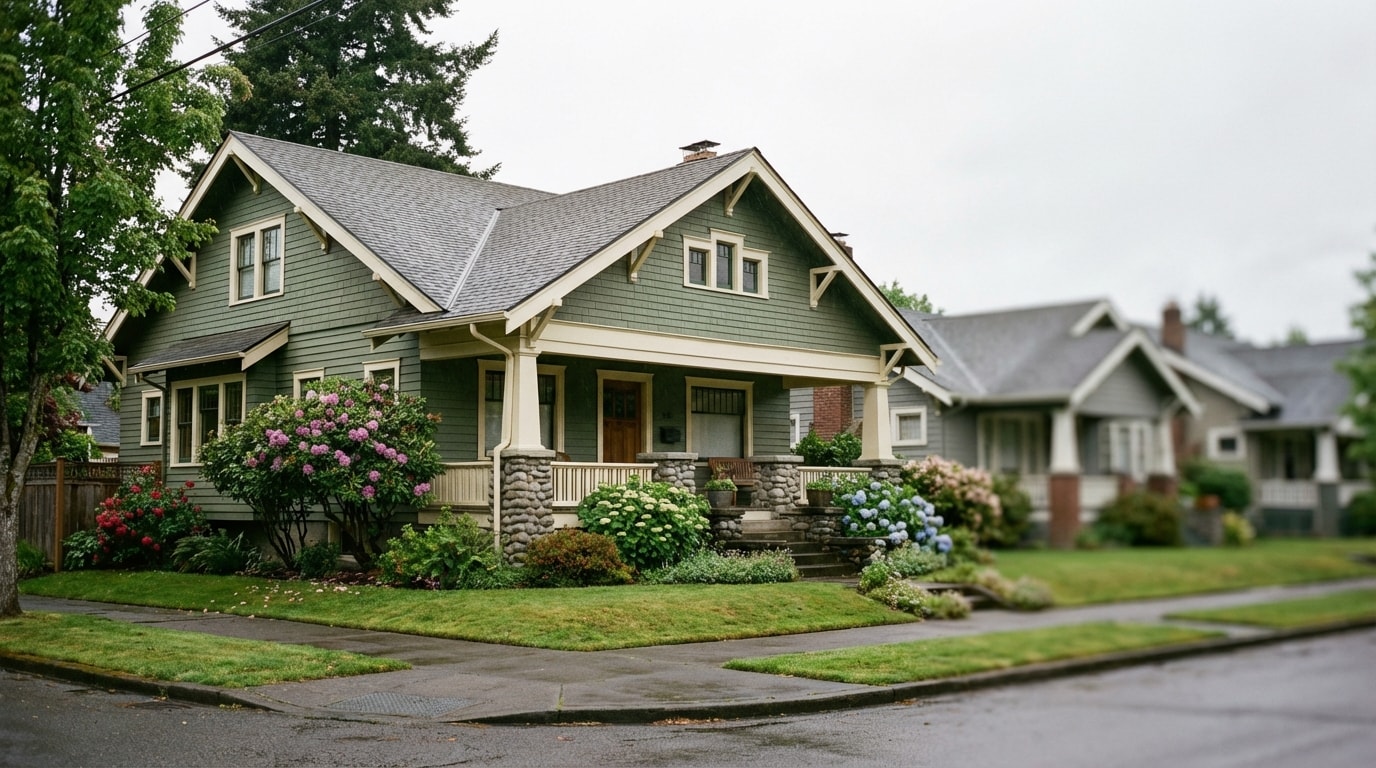
Alberta Arts has been one of the most active Portland re-roofing markets over the last decade because of two converging dynamics. The 1900–1935 Craftsman bungalow housing stock that defines this neighborhood is in active replacement cycles for the original or first-replacement asphalt roofs that went on in the 1970s–1990s. And the post-2010 gentrification that's reshaped NE Alberta Street has brought a homeowner profile that runs lifecycle economics rather than minimum upfront cost, premium architectural, AR-granule shingles, and standing seam metal uptake are all higher in this neighborhood than the Portland average.
The dominant Alberta housing stock is the 1,300–1,800 sq ft 1900–1925 Craftsman or bungalow with original cedar deck planks. The skip-sheathed deck overlay story applies here exactly as it does in Hawthorne and Sellwood-Moreland, overlay adds $2,200–$4,200 to a typical project and is almost universal on pre-1925 stock. The variable is whether tear-off reveals significant deck damage from sustained moss colonization (more common on north-facing slopes under heavy canopy) or sound original decking that just needs the modern plywood overlay.
Tree canopy in Alberta is meaningful but slightly below the upper Inner SE neighborhoods. The streets adjacent to NE Alberta and Killingsworth are less canopied than Hawthorne or Sellwood; the streets between NE Alberta and NE Prescott have heavier canopy where moss management becomes a significant ongoing cost. Plan on biennial chemical treatment and zinc ridge strip installation as part of any new roof in heavy-canopy locations.
The post-2010 neighborhood transition has also brought tighter contractor scrutiny. Alberta homeowners more frequently verify CCB licensing, request three competing bids, and ask for written workmanship warranties as a baseline. Established Portland roofing contractors compete on Alberta projects more aggressively than they do in most NE Portland neighborhoods because the buyer profile pays attention. The practical effect is tighter bid spreads on equivalent scope.
ALBERTA ARTS DISTRICT COST DRIVERS
The factors that move Alberta Arts District roofing quotes most, with quantified impact and the explanation behind each. Use these to evaluate whether a contractor's bid reflects local conditions or is missing something.
Universal on Alberta Craftsmans and bungalows. Per-sheet rate must be specified pre-bid.
Higher than NE Portland average reflects post-2010 buyer profile. Premium AR-granule and 50-year designer products are common spec.
Streets between NE Alberta and NE Prescott see meaningful canopy density. Zinc ridge strip plus biennial treatment standard for these locations.
Significant share of Alberta homes had original cedar replaced with 1990s asphalt. Both layers must come off for modern install.
Frequent ask in Alberta, neighborhood profile runs solar economics during re-roofing decisions.
ALBERTA ARTS DISTRICT REPLACEMENT BREAKDOWNS
Three representative Alberta Arts District replacement projects with line-item breakdowns drawn from typical local housing stock. Use these to anchor what your own quote should look like.
| Tear-off and disposal (single-layer 1990s asphalt) | $1,800 |
| Plywood overlay over skip-sheathed deck (22 sheets) | $2,420 |
| Synthetic underlayment + ice-and-water at eaves | $540 |
| Premium architectural shingles, GAF Timberline UHDZ | $5,400 |
| Ridge vent + soffit baffle upgrade | $580 |
| Pipe boots, step flashing, drip edge | $420 |
| Solar-ready conduit installation | $240 |
| Permit + BDS inspection | $280 |
| Cleanup and disposal | $340 |
| Total | $12,020 |
Note: Solid mid-tier Alberta replacement. The premium UHDZ shingle is a $1,200 upgrade over base architectural, common ask in Alberta for the 50-year warranty and 130 mph wind rating. Solar-ready conduit at $240 is a no-brainer add for any homeowner with future solar plans.
| Two-layer tear-off (cedar + 1990s asphalt) | $2,400 |
| Plywood overlay (24 sheets) | $2,640 |
| Deck repair (3 sheets at NW slope) | $390 |
| Synthetic underlayment + ice-and-water at eaves and valleys | $680 |
| Architectural shingles, Malarkey Vista AR | $5,200 |
| Ridge vent + soffit baffle install | $680 |
| Zinc ridge strip moss prevention | $280 |
| Permit + BDS inspection | $320 |
| Cleanup and disposal | $420 |
| Total | $13,010 |
Note: Two-layer tear-off and full plywood overlay are standard for 1920s Alberta stock that received the original cedar replacement in the 1990s. Malarkey Vista AR is the strongest moss-resistant asphalt, meaningful upgrade in this canopy environment.
| Tear-off existing architectural over original cedar | $2,000 |
| Plywood overlay (22 sheets) | $2,420 |
| Synthetic high-temp underlayment | $680 |
| 24-gauge standing seam panels (charcoal) | $10,800 |
| Trim, ridge, hip, valley, gable | $1,800 |
| Solar-ready conduit installation | $240 |
| Permit + BDS inspection | $320 |
| Cleanup and disposal | $420 |
| Total | $18,680 |
Note: Metal premium of roughly $6,500 over architectural asphalt replacement. The 1912 deck required overlay regardless of material, so the metal vs. asphalt comparison was straightforward. Solar-ready conduit was already specified during pre-bid given the home's south-facing roof orientation.
PERMITTING IN ALBERTA ARTS DISTRICT
Standard Portland BDS permit. Some properties on NE 30th–34th near the King Neighborhood face Type II review. Most replacements clear in 5–7 business days.
- ▸Properties on Portland's Historic Resource Inventory require Type II Historic Resource Review
- ▸Properties on NE 30th–34th near the King Neighborhood may face additional review on visible material changes
- ▸Re-roofing over an existing layer typically not permitted, full tear-off required
- ▸Attic ventilation ratio (1:300 balanced) actively reviewed at final inspection
ALBERTA ARTS DISTRICT AT A GLANCE
- ▸NE Alberta Street commercial spine with surrounding 1900–1935 Craftsman bungalow stock
- ▸Post-2010 gentrification has brought premium spec uptake to a historically affordable area
- ▸Sabin and Concordia residential adjacency, overlapping moss pressure and similar housing patterns
ROOFING SERVICES IN ALBERTA ARTS DISTRICT
All five services covered by the same Alberta Arts District crews. Local cost intelligence on this page applies to every service type, material choice shifts the absolute number, but the Alberta Arts District-specific drivers (deck, canopy, permit, design review) apply across the board.
ALBERTA ARTS DISTRICT CATCHMENT
Our Alberta Arts District crews also cover these adjacent neighborhoods and surrounding communities. Same pricing, same CCB-licensed work, same local permit knowledge.
- Sabin
- Concordia
- King Neighborhood
- Vernon
- Cully (border)
- Beaumont (south edge)
- Hollywood (border)
ALBERTA ARTS DISTRICT ROOFING QUESTIONS
How much does a roof replacement cost in Alberta Arts District?
The average replacement in Alberta Arts District (97211) costs $9,600, typically ranging $7.2k–$14.5k. Most common material: Architectural Asphalt.
How difficult is it to get a roofing permit in Alberta Arts District?
Alberta Arts District has a permit difficulty score of 3/5 (Moderate). Standard Portland BDS permit. Some properties on NE 30th–34th near the King Neighborhood face Type II review. Most replacements clear in 5–7 business days.
What roofing contractors serve Alberta Arts District?
Multiple licensed Oregon CCB contractors operate in Alberta Arts District. Our platform vets all contractors against a 47-point checklist. Use our free quote form to get matched within 48 hours.
Why is Alberta Arts more expensive than other NE Portland neighborhoods?
Two reasons. First, the post-2010 gentrification has brought a homeowner profile that runs lifecycle economics, premium architectural, AR-granule shingles, and standing seam metal uptake are all higher than the NE Portland average, which pulls average project cost up. Second, established Portland roofing contractors compete more aggressively for Alberta projects because the buyer profile pays attention to CCB licensing, three-bid comparisons, and written workmanship warranties as baselines.
Should I expect skip-sheathed deck overlay on my Alberta Craftsman?
Almost certainly yes if your home is pre-1925. Skip-sheathed decking (1×4 boards with gaps) was code-compliant for cedar shake but cannot support modern asphalt shingle attachment patterns. Plan for $2,200–$4,200 in plywood overlay material and labor. Per-sheet rate runs $90–$130 installed. Get the rate in writing before signing, quotes that don't include the overlay are either incomplete or assume a deck condition the contractor hasn't actually verified.
Is metal worth specifying in Alberta?
For homeowners staying 12+ years and particularly those with future solar plans, yes. Metal eliminates the moss-treatment cycle entirely, outlasts asphalt by roughly 2x in this canopy environment, and clamp mounting on standing seam means future solar installation requires no roof penetrations. The $5,000–$7,500 premium pays back through avoided maintenance and avoided replacement cycles. Solar-ready specification at install is the cleanest cost-effective add for any Alberta homeowner with future solar plans.
How does Alberta canopy compare to Hawthorne or Sellwood?
Slightly lighter overall but heavily location-dependent. The streets adjacent to NE Alberta and NE Killingsworth are less canopied than Hawthorne or Sellwood-Moreland. The residential streets between NE Alberta and NE Prescott, particularly NE 17th through NE 30th, have meaningful canopy density that drives moss-related shingle premiums. Plan for biennial chemical treatment and zinc ridge strip installation on canopied locations.
What's the right shingle spec for Alberta's mix of canopy and exposure?
AR-granule architectural shingles at minimum, Malarkey Vista AR or GAF Timberline HDZ AR are the strongest performers in Portland's moss-pressure environment. Premium 50-year products (GAF Timberline UHDZ, CertainTeed Landmark Pro) add $1,000–$1,500 over base architectural and offer 130 mph wind ratings plus better long-term performance, recommended for any homeowner staying 10+ years.